About the Journal
Focus and Scope
The International Journal Sportis aims to publish and disseminate research articles related to Physical Education, Sport Sciences, and Psychomotricity in children, young people, and adults. Authors may submit works developed in the field of analytical research — theoretical, historical, or synthesis reviews — quantitative research, experimental research, and/or qualitative research.
Sportis is published monthly, with a total of 12 issues per year. Issues are published on the 1st day of each month.
The journal is published by Campus Educa Sportis.
Thematic Areas and Specialties
The three main thematic areas of the journal include the following subareas:
Area 1. Sport Sciences
1.1. Sport pedagogy
1.2. Management and technical direction of sport schools
1.3. Organization of sport schools and sport events
1.4. Foundations of training physical capacities
1.5. Physical exercise and health
1.6. New sport trends
1.7. Inclusion and integration through sport
1.8. Evaluation and quality of sport programmes
1.10. Stakeholders involved in sport
1.11. Sport policy. Socio-sport programmes
1.12. Injury prevention in sport
1.13. First aid in sport
1.14. Women in sport
1.15. Physical exercise for the prevention and rehabilitation of pathologies and diseases
1.16. Recreation and leisure in sport
1.17. Psychology, sociology, and anthropology of sport
1.18. Sports medicine, physiotherapy, and nutrition in sport
1.19. Sport competition
1.20. Refereeing and judging in sport. Sport regulations
1.21. Research projects in sport
1.22. The training session in sport
1.23. Anatomy, physiology, and kinesiology in athletes
1.24. Sport and extracurricular activities
1.25. Sport technique and tactics
1.26. Planning and programming of sport training
1.27. Physical preparation in athletes
1.28. Civil liability in sport
1.29. Olympic movement in the sport population
Area 2. Physical Education
2.1. Basic competences through Physical Education
2.2. Curricular adaptations for students with functional diversity
2.3. Physical Education and the educational curriculum
2.4. Healthy habits and Physical Education
2.5. The Physical Education session and teaching units
2.6. Assessment in Physical Education
2.7. New trends in Physical Education. Teaching proposals
2.8. Games and recreational-sport activities
2.9. Innovation and research in Physical Education
2.10. Popular and traditional games and sports
2.11. Sport and socio-cultural animation
2.12. Outdoor activities
2.13. Didactics and pedagogy of Physical Education
2.14. Body expression and artistic techniques in Physical Education
2.15. Civil liability in the Physical Education classroom
2.16. Prevention of violence through Physical Education
2.17. Physical Education and values, coeducation, and gender equality
2.18. Accident prevention at school
Area 3. Psychomotricity
3.1. Infant motor development from 0 to 2 years
3.2. Infant motor development from 3 to 6 years
3.3. Learning, development, and motor control through physical activity
3.4. Early stimulation in children
3.5. Foundations of the development of psychomotricity factors
3.6. Motor skills
3.7. Sensory stimulation in children
3.8. Motor games
3.9. Motor songs and motor stories
3.10. Relaxation and cool-down games
3.11. Motor intervention programmes in early childhood education
3.12. Research in psychomotor practices
3.13. Psychomotor assessment
3.14. Psychomotor therapy and rehabilitation
Peer Review Process
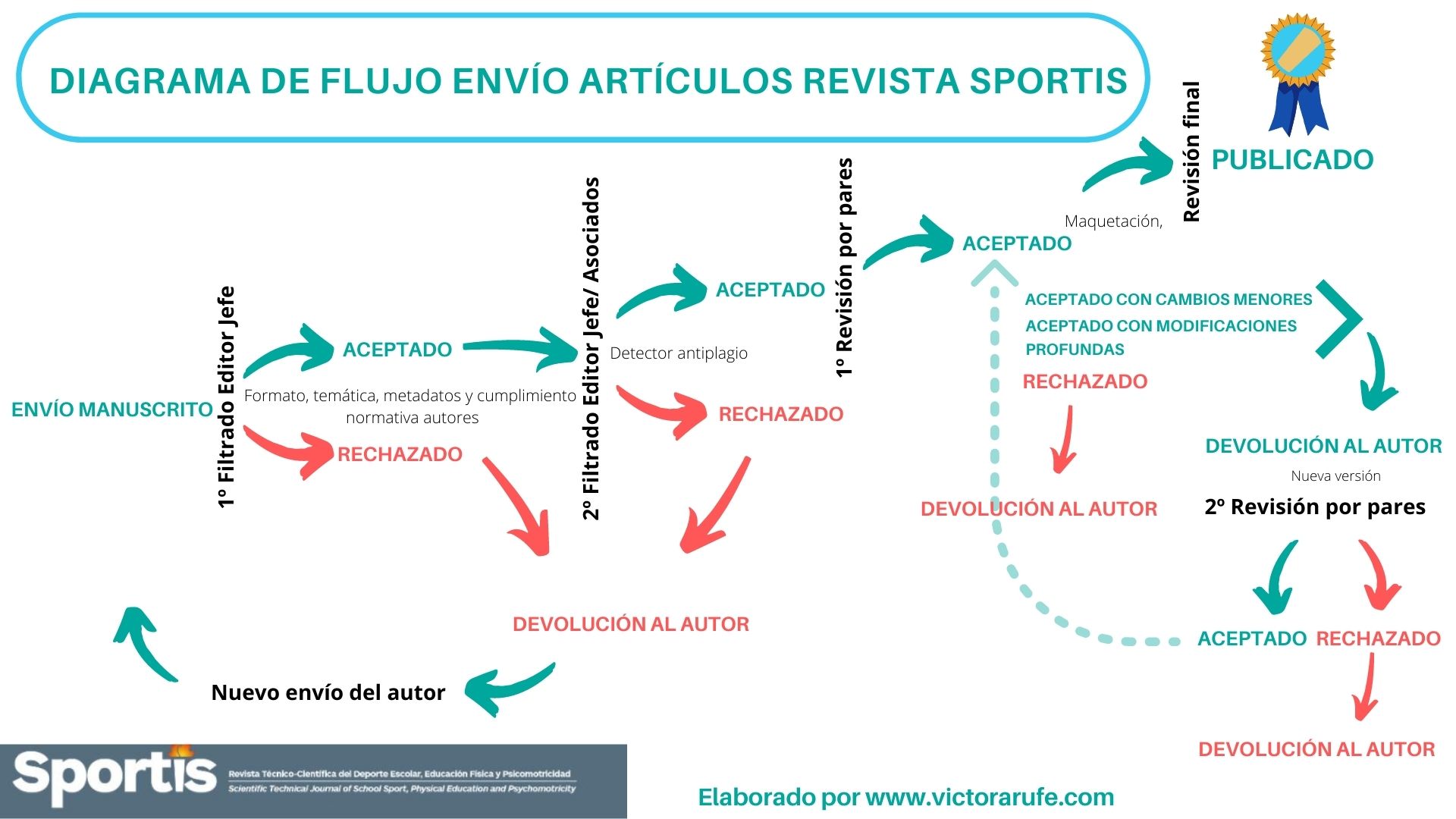
All manuscripts received will first be reviewed by the Editor-in-Chief or, in their absence, by the Section Editors, who will decide whether the article falls within the editorial scope of the journal and whether it meets the formal requirements established in the author guidelines. In this first phase, the manuscript will also be checked using plagiarism detection software.
Manuscripts that do not meet these formal requirements, exceed a plagiarism percentage of 20% without justification, or contain an excessive percentage of self-citations without justification, will be returned to the authors so that they may adapt the manuscript to the current guidelines. Manuscripts that do not fit the editorial scope of the journal will be rejected for publication.
Works that comply with the current guidelines and fit the editorial scope of the journal will be sent anonymously to at least two members of the Scientific Committee and/or external reviewers for review. The review process follows a double-blind peer review system. Articles may be rejected, accepted with modifications, or accepted without modifications.
The average review period will range from 15 to 45 days. Once this period has elapsed, the editor undertakes to send a decision to the author of the article. This timeframe may be extended depending on reviewer availability or holiday periods.
Publication Frequency
Accepted articles will be scheduled for publication in an issue of the journal as soon as possible. The journal publishes a total of 12 issues per year. Publication dates are always the 1st day of each month.
Open Access Policy
This journal provides immediate open access to its content, based on the principle that making research freely available to the public supports a greater global exchange of knowledge.
The journal does not charge readers any fee to access scientific articles, nor does it require subscription fees.
However, as the journal does not receive external funding, whether public or private, to guarantee full coverage of its costs, the journal’s management is required to charge authors a small fee to cover expenses derived from the editorial process, including:
- Web hosting and maintenance
- Design, layout, and production
- Orthotypographic and scientific revision
- Peer review process
- Issuing of certificates
- Secretarial work and email support
- Dissemination on social media
- Metadata correction
- DOI registration, indexing, and other associated costs
- Legal Advisory
- Taxes
- Registered Office
The editorial fee is 300 euros for articles submitted from june 1, 2026 onwards; previously, the fee was 200 euros. This fee will only be paid if the article is accepted. Submission of manuscripts and peer review are completely free of charge.
Editorial Good Practices in Gender Equality
Use of Inclusive and Non-Sexist Language
Sportis Sci J follows an editorial policy that includes specific recommendations in favour of the use of inclusive language in scientific articles. Authors must use terms that refer to both sexes. Examples include: students, teachers, childhood, children, people, human beings, teaching staff, research staff, etc. Authors must always include both surnames of all personnel who participated in the research.
In line with our editorial policy, we strongly recommend that authors use inclusive and non-sexist language in their scientific articles. These recommendations are designed to ensure that all works published in our journal respect and reflect the diversity of our scientific community, promoting equality and avoiding any form of discrimination.
Some guidelines to follow include:
- Use of neutral pronouns: use inclusive pronouns or forms that include all genders when referring to individuals in general.
- Avoid gender stereotypes: write in a way that avoids traditional gender stereotypes and roles.
- Neutral language: prefer gender-neutral terms such as “people” instead of “men” or “women”, unless specification is necessary.
- Equitable recognition: ensure that the contributions of all people involved in the research are acknowledged, regardless of gender.
- Forms of reference: when referring to professionals, use their title and full name, and not only their surname, to avoid gender bias.
These recommendations are in line with our commitment to equity and diversity in science. We appreciate the cooperation of all authors in implementing these practices in their manuscripts.
We recommend that authors of published works based on research data including the sex variable report whether the conclusions have taken possible differences between sexes into account.
Plagiarism Detection
Sportis uses Crossref’s Similarity Check plagiarism detection software. All articles are checked using plagiarism detection software before being sent for peer review. If the editor observes a plagiarism percentage above 20% or an excessive percentage of unjustified self-citations, the article will automatically be returned to the author without proceeding to peer review. The plagiarism detection tool is used twice during the editorial process: when the article is first received and on the final version of the article before publication.